


|


|
|
|
Home Contact us About us Iran highlights Guides |

Ski, Sun, Sea and Sand
You will have the chance to enjoy skiing. We will also invite you to the Kish Island, the pearl of the Persian Gulf so that you can enjoy sun bathing under the blazing sun in the coral beaches, lying on the white & silver sands, swimming in the warm crystal sea, and of course diving & watching extraordinary under-water life.
Itinerary:
Day 1: ARRIVE TEHRAN After arrival in Tehran, you will be met by our representative for the transfer to your hotel. The morning is at your leisure to relax. After lunch, begin your tour of Tehran. Visit the Crown Jewels Museum with its impressive collection of precious gems and dazzling works of art. Continue on to Sa'dabad Palace and the Museum of Reza Abbasi, named after the most famous miniaturist of Safavid era. The museum, opened in 1977, exhibits artifacts dating back to prehistoric and Islamic periods, and is particularly rich in calligraphy. (A manteau "overcoat" will be given to female travelers upon arrival)
Day 2: TEHRAN-Dizin Drive to Dizin. Dizin is situated on the north mountains of
Tehran at Gajereh region, where its distance from Chaloos road is 123
kilometers, and by Shemshak is 71 kilometers. Dizin climatological condition offers the
longest time for skiing, normally begins in (22 N0V. -22 MAY) Because of the
expansion of the region. In 1372 (1993) taking the viewpoints of the
International Ski Federation into consideration, and with regard to the
co-operation of the concerned experts in this field, the cornerstone of
Grasski was laid down after a year endeavor, it was opened to public in
1994. In 1375 (1996) the first international Grasski
tournament was held at Dizin in which some famous countries participated,
The International Ski Federation representatives while expressing their
agreement that these possibilities are suitable and comply with
international standards, agreed that the grass ski contests be held in
Iran, and thus they handed over the Presidency of the West-Asian Grass ski
competitions to Iran. Apart from grass ski there are also other facilities
such as tennis courts, heights for mountain climbing, different tracks for
cyclists in mountainous region
Step-by-step ski training courses are offered
to the trainees skilful ski trainers and sport lovers as well as those who
love and want to spend their time in the beautiful and affricative mountain
sites. Open to public Winter, weekdays Summer,
Thursdays, Fridays & holidays. Skiing in Dizin. Stay overnight in Dizin. Day 3: Dizin Skiing in Dizin. Stay overnight in Dizin. Day 4: YAZD Drive to yazd. Transfer tho the
hotel. In the evening visit the Zoroastrian Towers of Silence, and the Fire Temple, whose fire has allegedly burned continuously for over a thousand years.
Visit the local famous Jameh and Mir-Chakhmaq Mosques, overnight stay in Yazd. Day
5: YAZD In the morning visit the Desert around Yazd. Dasht-e Kavir ,great salt desert, c.500
mi (800 km) long and c.200 mi (320 km) wide, SE of the Elburz Mts., N
central Iran. It is a huge basin of interior drainage named after the kavirs
(salt marshes) located there. The "Kavir Buzurg" (Great Kavir), c.200 mi (320
km) long and c.100 mi (160 km) wide, lies in the heart of the region; low
sandy hills separate it from smaller kavirs. An almost rainless climate with
strong surface
Day
6: ISFAHAN is a wonder. Truly a city of splendor, legend has it that the city was founded at the time of Tahmourass or Keykavous. During the Safavid Era (sixteenth and seventeenth century AD), Isfahan was a city of Gardens and Palaces. As a major trade center of its time, Isfahan's was known as "Half the World." Your full day tour includes the famed Imam Square (Naqsh-e-Jahan), a huge square second in the world to Beijing's Tiananmen Square. Tour the architectural marvels of Sheikh Lotfollah and Imam Mosques, Aliqapu Palace, Chehel Sutoon Palace, and also visit one of the most famous bazaars in Iran, where you can purchase the arts & crafts for which Isfahan is so well renowned.
Stay overnight in Isfahan. Day
8: SHIRAZ- PERSEPOLIS Drive to Shiraz. Enroute visit Pasargadea,
Naghsh-e Rustam and Persepolis. One of the highlights of any tour of Iran is a visit to Shiraz and to neighboring Persepolis, the capital of Darius. Shiraz is traditionally known as the city of Roses and Nightingales, but has become known in recent times as a seat of intellectual learning. It was home to Saadi and Hafez, the famed Persian poets, and is considered the cradle of Persian Civilization. Persepolis, which in Greek literally means the capital of Persia, lies 36 miles north of Shiraz. Persepolis is the ultimate expression of the ancient Middle East. Construction began by Darius the Great (521 - 468 BC) as the focus of the mighty Achaemenian
Empire nearly 2,500 years ago. Tansfer to the hotel.
Day
10: Sepidan Drive to Sepidan. Enroute visiting Sheshpir lake.
Picturesque landscapes, green valleys, ravishing waterfalls, snow-shrouded
mountains, tranquil rivers, mild summer and cold snowy winter and hospitable
citizens are the major features which make Sepidan
the final destination.
Day
11: Skiing in Sepidan. Stay overnight in Sepidan.
Due to its natural attractions,
pleasant weather more than seven months a year, and several recreational and
sports centers, today the island has turned into a favorite tourism
destination in Iran and the region. Stay overnight in Kish. Day13: Kish Full city tour in Kish including: The Ancient Town of Harireh Most probably the ancient town of
Harireh is the same town mentioned by the renowned Persian poet Saadi in his
book Golestan. According to the writings of
Iranian and Arab historians, the town of Harireh had been located in the
center of the northern part of the island, where the ruins of the city can
be seen today. Visiting this ancient town is an
opportunity to get acquainted with the island�s history while having a nice
time at the Green Tree Recreational Complex, situated near the ancient city.
The inhabitants of Kish, in the
past, used a kind of traditional storage system to gather rainwater. These
storages were dug in the ground and built with a domed roof. With the
emergence of water desalination facilities, these storages lost their
significance. But their remnants are still an interesting site for tourists
to visit. Underground Town of Cariz The Kish qanat is more than 2,500
years old, and currently it has been converted into an underground town at
a depth of 16 meters below the surface, with an area of more than 10,000 sq
m. In the reconstruction of this
qanat named Cariz, spaces have been allocated to handicraft stalls,
restaurants and traditional teahouses, amphitheaters, conference centers,
and art galleries. Efforts have been made to preserve the traditional and
historic fabric of the site. Sunset by the Greek Ship Years ago, for some unknown
reason, a Greek cargo ship got close to Kish�s coasts and was stuck in the
mud. Watching the sunset beside this ship is fascinating and the atmosphere
created to rest near the ship is very popular with tourists.
Day15: Depart Tehran. |
 Tehran,
Yazd, Isfahan, Shiraz, Sepidan, Kish
Tehran,
Yazd, Isfahan, Shiraz, Sepidan, Kish which all in all absorb many champions and
sport lovers for competition from all over the world. For the
time being, Dizin is open to the public on summer holidays and every day in
the winter.
which all in all absorb many champions and
sport lovers for competition from all over the world. For the
time being, Dizin is open to the public on summer holidays and every day in
the winter. evaporation
has created a crust of salt over the marsh and mud lands. Chemical salts
balance the evaporation by drawing moisture from the substrata and the
atmosphere. It is almost uninhabited and
only partly explored; settlement is restricted to the hills and surrounding
mountains. Extending S from the Dasht-e Kavir is the Dasht-e Lut, a sand and
stone desert, c.300 mi (480 km) long and c.200 mi (320 km) wide; it consists
of dried-out kavirs and contains a large salt marsh. The two deserts occupy
most of the central Iranian plateau. P.M drive to Isfahan. Transfer to the
hotel.
evaporation
has created a crust of salt over the marsh and mud lands. Chemical salts
balance the evaporation by drawing moisture from the substrata and the
atmosphere. It is almost uninhabited and
only partly explored; settlement is restricted to the hills and surrounding
mountains. Extending S from the Dasht-e Kavir is the Dasht-e Lut, a sand and
stone desert, c.300 mi (480 km) long and c.200 mi (320 km) wide; it consists
of dried-out kavirs and contains a large salt marsh. The two deserts occupy
most of the central Iranian plateau. P.M drive to Isfahan. Transfer to the
hotel. Day
7: ISFAHAN Today's full day tour includes Hasht Behesht, Vank Church, the spectacular and historic Friday Mosque as well as the famous bridges. In particular, the "33 arch bridge" or "Si o Se Pol" dates from 1602 and is a colorful meeting place for locals to gather, drink tea, and refresh themselves.
Stay overnight in Isfahan.
Day
7: ISFAHAN Today's full day tour includes Hasht Behesht, Vank Church, the spectacular and historic Friday Mosque as well as the famous bridges. In particular, the "33 arch bridge" or "Si o Se Pol" dates from 1602 and is a colorful meeting place for locals to gather, drink tea, and refresh themselves.
Stay overnight in Isfahan. Day
9: SHIRAZ In the morning visit the tombs of the Persian poets Saadi and
Hafiz, Nasirol-Molk Mosque, the Church of Saint Simmon the Zealot and Vakil
Mosque. Your evening includes visiting Vakil Complex such as Zand citadel,
Vakil Mosque, Pars Meusum and Vakil Bazzar. Stay overnight in Shiraz.
Day
9: SHIRAZ In the morning visit the tombs of the Persian poets Saadi and
Hafiz, Nasirol-Molk Mosque, the Church of Saint Simmon the Zealot and Vakil
Mosque. Your evening includes visiting Vakil Complex such as Zand citadel,
Vakil Mosque, Pars Meusum and Vakil Bazzar. Stay overnight in Shiraz.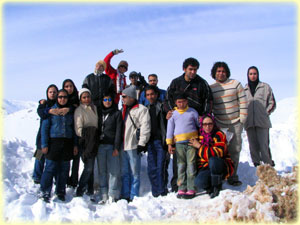 Sepidan
 Day12:
Kish Drive back to Shiraz. Fly to Kish. Transfer to the hotel. Around 40
years ago, when a group of western experts came to the island to survey its
tourism situation, they compared it with the best tourist islands in the
world and predicted a bright future for it. Since then Kish Island has
taken long and proud strides in order to realize the position that it
deserves.
Day12:
Kish Drive back to Shiraz. Fly to Kish. Transfer to the hotel. Around 40
years ago, when a group of western experts came to the island to survey its
tourism situation, they compared it with the best tourist islands in the
world and predicted a bright future for it. Since then Kish Island has
taken long and proud strides in order to realize the position that it
deserves. Ancient
water cellars
Ancient
water cellars Day14:
Kish In the morning going to the coast. The coral coasts of Kish Island
have a special glow under the sunlight. The seawater near the coasts is so
clear, that one can see the depths of the sea and all its aquatic life that
are unique in their kind. These beaches are safe and there are no dangerous
creatures in the region; thus those interested in fishing and swimming can
go for their favorite sports. Tourists can b
Day14:
Kish In the morning going to the coast. The coral coasts of Kish Island
have a special glow under the sunlight. The seawater near the coasts is so
clear, that one can see the depths of the sea and all its aquatic life that
are unique in their kind. These beaches are safe and there are no dangerous
creatures in the region; thus those interested in fishing and swimming can
go for their favorite sports. Tourists can b
| |