|
|
Cool Tour
Tour Request Process
 Day 1: ARRIVE TEHRAN After a pre-dawn arrival in Tehran, you will be met by our representative for the transfer to your hotel. The morning is at your leisure to relax. After lunch, begin your tour of Tehran. Visit the Crown Jewels Museum with its impressive collection of precious gems and dazzling works of art. Continue on to Sa'dabad Palace and the Museum of Reza Abbasi, named after the most famous miniaturist of the Safavid era. The museum, opened in 1977, exhibits artifacts dating back to prehistoric and Islamic periods, and is particularly rich in calligraphy. (A manteau "overcoat" will be given to female travelers upon arrival) Day 1: ARRIVE TEHRAN After a pre-dawn arrival in Tehran, you will be met by our representative for the transfer to your hotel. The morning is at your leisure to relax. After lunch, begin your tour of Tehran. Visit the Crown Jewels Museum with its impressive collection of precious gems and dazzling works of art. Continue on to Sa'dabad Palace and the Museum of Reza Abbasi, named after the most famous miniaturist of the Safavid era. The museum, opened in 1977, exhibits artifacts dating back to prehistoric and Islamic periods, and is particularly rich in calligraphy. (A manteau "overcoat" will be given to female travelers upon arrival)
Day 2: TEHRAN This morning's tour
includes the Archaeological Museum with its fine collection of artifacts,
including a stone capital of a winged lion from Susa, and a sixth century BC
audience hall relief of Darius the Great recovered from the Treasury at
Persepolis. The museum contains items that date back from the Sumerian Period
(4500 BC) to the contemporary. Also, visit the Carpet Museum with its superb
collection of Persian rugs and carpets. Fly to Kish Island in the afternoon,
visiting the beautiful sunset.
Day 3: KISH
Free at leisure . At night fly to shiraz.
 Day 4: SHIRAZ
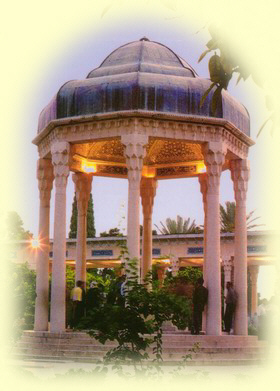
is the capital of Fars Province. Enjoy your tour with visits to the Eram
Garden, the tombs of the Persian poets Sa'di and Hafiz, Nasirol-Molk Mosque,
Afif-Abad Garden, the Church of Saint Simon the Zealot, Vakil Mosque, and the Shrine of Shah-Cheragh
"King of Light", noted for its dazzling mirror tiles. Day 4: SHIRAZ
is the capital of Fars Province. Enjoy your tour with visits to the Eram
Garden, the tombs of the Persian poets Sa'di and Hafiz, Nasirol-Molk Mosque,
Afif-Abad Garden, the Church of Saint Simon the Zealot, Vakil Mosque, and the Shrine of Shah-Cheragh
"King of Light", noted for its dazzling mirror tiles.
Day 5: SHIRAZ- PERSEPOLIS Persepolis, which in Greek literally means the capital of Persia, lies 36 miles north of Shiraz. Persepolis is the ultimate expression of the ancient Middle East. Construction began by Darius the Great (521 - 468 BC) as the focus of the mighty Achaemenian Empire nearly 2,500 years ago. Spend a full day exploring these mighty ruins. Your tour will also include the Kuh-i-Rehmat, Nagsh-e-Rustam (Tomb of Rustam) and Nagsh-e-Rajab.
Fly to Isfahan .
Day
6: ISFAHAN Isfahan is a wonder. Truly a city of splendor, legend has it that the city was founded at the time of Tahmourass or Keykavous. During the Safavid Era (sixteenth and seventeenth century AD), Isfahan was a city of Gardens and Palaces. As a major trade center of its time,
Isfahan was known as "Half the World." Your full day tour includes the famed Imam Square (Naqsh-e-Jahan), a huge square second in the world to Beijing's Tiananmen Square. Tour the architectural marvels of Sheikh Lotfollah and Imam Mosques, Aliqapu Palace, Chehel Sutoon Palace, and also visit one of the most famous bazaars in Iran, where you can purchase the arts & crafts for which Isfahan is so well renowned.
Day 7: ISFAHAN Today's full day tour includes Hasht Behesht, Vank Church, the spectacular and historic Friday Mosque as well as the famous bridges. In particular, the "33 arch bridge" or "Si o Se Pol" dates from 1602 and is a colorful meeting place for locals to gather, drink tea, and refresh themselves.
Day 8: ISFAHAN - GULPAYGAN Drive to
Gulpaygan the city of honey and flowers. enjoy visiting its marvelous nature.
It is a famous city for its Dairy .Stay overnight in the historical citadel of
Gugad. It has now been changed to an interesting traditional hotel.
Day 9: GULPAYGAN Stay in Gulpaygan .
Visit Khansar the city of honey in Iran.
 Day 10: MAHALAT Drive to Mahalat. You can use the Mahalat spas with its wonderful curing effect. The Mahalat town is one of the important areas from the point of view of thermal springs in Iran. Due to geological specifications, there are many seasonal springs, mainly in the mountainous areas, and some of them are very important because of their vast area, green surroundings and easy access to recreational spots. The temperature of the water is 50 centigrade and is effective in healing different kinds of diseases such as gout, diseases related to kidneys, liver, etc. There are two different kinds of thermal springs in Mahalat according to their chemical compositions and effects.
These are called healing and rheumatism springs. Day 10: MAHALAT Drive to Mahalat. You can use the Mahalat spas with its wonderful curing effect. The Mahalat town is one of the important areas from the point of view of thermal springs in Iran. Due to geological specifications, there are many seasonal springs, mainly in the mountainous areas, and some of them are very important because of their vast area, green surroundings and easy access to recreational spots. The temperature of the water is 50 centigrade and is effective in healing different kinds of diseases such as gout, diseases related to kidneys, liver, etc. There are two different kinds of thermal springs in Mahalat according to their chemical compositions and effects.
These are called healing and rheumatism springs.
Day 11: MAHALAT Using Spas : Mahalat Thermal Spring, Mahalat
The Mahalat thermal spring is located to the northeast of
Mahalat
city. This spring is one of the most important mineral water springs in
Markazi province.
It is one of the deep thermal springs which become warm through vapors of
burning stones of inner layers of the earth and finally reach the surface. The
Mahalat Thermal Spring has attracted tourists since long ago. Every year
thousands of people come to this area, in
order to cure their diseases. The best
season to make use of Mahalat thermal springs is spring and summer. Near these
thermal springs, many hotels, a tourist lodge and a public bath was built. The
inhabitants believe that the amount of warm water has increased after the
earthquake which took place 40 years ago. Near the Mahalat thermal spring,
there are several mineral springs. The most important ones are: the Shafa,
Suleiman and Hakim Springs which are effective in healing many skin and
rheumatic disorders.
Mahalat Sarcheshmeh Spring, Mahalat
The Mahalat Sarcheshmeh spring has an excellent capacity of
water and is located in the highest point of
Mahalat
city in this province. It has since past attracted many tourists. It is said
that this spring was the main reason of establishment of Mahalat city. Near
this spring there is a beautiful park, beautiful fountains, huge trees, old
plane trees, rocky heights, with pleasant weather which annually attract many
people.
Day 12: MAHALAT-HAMEDAN
Move to Hamedan . In the evening visit Hamedan.
 Day 13: HAMEDAN
A city in western Iran, located in a productive
farming region. The capital of Hamadan Province, the city is known for the
manufacture of rugs, leather trunks, ceramics, and copper ware. It is the
center of the Iranian shellac and leather trade and is commercially important
because of its position on the principal route between Baghdad and Tehran. The
city of Hamadan has a number of bazaars and several mosques. Also in the city
are two tombs of special interest, one claimed to be that of the Biblical
Mordecai and Esther, and the other that of the Islamic philosopher-physician
Avecina. The city is believed to occupy the site of the city of Ecbatana,
capital of the ancient Medes. During World War I, Hamadan was the
scene of fighting between Russian and Turk-German forces. The city was held at
various times by the Russians, the Turks, and the British before being
restored to Iranian government control in 1918. The town's places of interest
are: Avicena's tomb and Museum, tomb of Baba Taher (Iranian mystic and
wandering dervish who died in 1019 A.D., and Ganjnameh, Hamadan's oldest
Achaemenian rock carvings consisting of two huge inscribed panels (twenty
lines) carved on two rock faces of some two meters in height, located 5 km.
west of the city on the slopes of Mount Alvand. You will visit Ali-Sadr cave
there. The most beautiful cave you have ever seen . Day 13: HAMEDAN
A city in western Iran, located in a productive
farming region. The capital of Hamadan Province, the city is known for the
manufacture of rugs, leather trunks, ceramics, and copper ware. It is the
center of the Iranian shellac and leather trade and is commercially important
because of its position on the principal route between Baghdad and Tehran. The
city of Hamadan has a number of bazaars and several mosques. Also in the city
are two tombs of special interest, one claimed to be that of the Biblical
Mordecai and Esther, and the other that of the Islamic philosopher-physician
Avecina. The city is believed to occupy the site of the city of Ecbatana,
capital of the ancient Medes. During World War I, Hamadan was the
scene of fighting between Russian and Turk-German forces. The city was held at
various times by the Russians, the Turks, and the British before being
restored to Iranian government control in 1918. The town's places of interest
are: Avicena's tomb and Museum, tomb of Baba Taher (Iranian mystic and
wandering dervish who died in 1019 A.D., and Ganjnameh, Hamadan's oldest
Achaemenian rock carvings consisting of two huge inscribed panels (twenty
lines) carved on two rock faces of some two meters in height, located 5 km.
west of the city on the slopes of Mount Alvand. You will visit Ali-Sadr cave
there. The most beautiful cave you have ever seen .
Day 14: KERMANSHAH
Visiting Kermanshah .The
provincial capital of Kermanshah is an important agricultural center in
western Iran, and was famous in ancient times for its superb breed of horses
and excellent vineyards. It is also the land of the Kurds, proud people who
maintain their own language and colorful mode of dress. The relief of Darius'§
victory over rebels at Bistoon near the town of Kermanshah and at Taq-e
Bostan, a number of relieves have been carved out of the mountainside, and
covered by a vault. Outside, Qajar kings have also been depicted enthroned, in
the style of their Sassanian forbears. The Tekiyeh-e Mo'avenol-ol Molk is one
of Kerman shah's religious sites, providing a beautiful example of Qajar (19th
century) painting and tile-work. Fly
to Tehran Day 15: DEPART TEHRAN
Tour Request Process |