For the
convenience of those tourists who intend to travel from Europe to
southeast of Asia or vice verse, Pars Tourist has designed Iran Cross
tours. These tours are being operated on 1st and 15th
of each month starting from Mirjaveh and Bazargan borders.
For the
convenience of those tourists who intend to travel from Europe to
southeast of Asia or vice verse, Pars Tourist has designed Iran Cross
tours. These tours are being operated on 1st and 15th
of each month starting from Mirjaveh and Bazargan borders.
Those
interested to participate in these tours should send their requests 15
days before the starting dates of the tour for registering to get Iran
visa.
Normally,
Iran Cross tours are being operated in economy class in 1 star hotels. But
it is also possible to arrange in higher class accommodation, if there is
any request to change the class of the tours.
Cross
Southeast of Asia with Iran Cross Tours!
Mirjaveh,
Bam, Kerman, Mahan, Rayn, Yazd, Shiraz, Persepolis, Isfahan, Tehran,
Tabriz, Bazargan.
Tour Itinerary
Day 1:
MIRJAVEH - BAM Arrive in Mirjaveh border at 10 am. After documents
checks, move toward Bam
Day 2: BAM
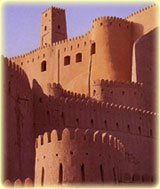
� KERMAN Bam is located in a vast plain
between the two mountain ranges of Barez and Kabudi.
City tour in Bam. Have a visit to the
ruins of Bam citadel which used to be considered as the largest city of
the world that is made of sun dried bricks before the earthquake in 2003. Leaving for Kerman and visiting several
beautiful lakes on the way. Set in the tranquil desert, Kerman has a
long and turbulent history. The old part of the city has the famous Jameh
Mosque dates back to the 14th century.
 Day 3:
KERMAN � MAHAN City tour in Kerman with visits to Ganjali Khan
Complex including its bath and bazaar. This
complex has been built during the Safavid era (1499 - 1723 AD) enjoying a
modern architectural style of the time.
Out of Ganjali Khan Complex, the Khan public bath located in the grand
bazaar of Kerman serves as an anthropology museum today. This is a unique
work of architecture with beautiful tile works, paintings, stuccos, and
arches.
We will also visit Jameh mosque.
Drive to Mahan, well known as the final home of Shah Nematollah
Vali, the Sufi saint and poet. The poet spent many years wandering through
Central Asia before finally settling at Mahan, where he was taken with the
surrounding violet-colored mountains. His tomb is an excellent example of
the importance that traditional Persian architecture places on harmony
between nature and physical structures. Visit the Shahzadeh Garden in
Mahan, and then drive to Rayn in Shahdad Desert to visit its beautiful old
castle under the sky of Shahdad desert full of stars.
Day 3:
KERMAN � MAHAN City tour in Kerman with visits to Ganjali Khan
Complex including its bath and bazaar. This
complex has been built during the Safavid era (1499 - 1723 AD) enjoying a
modern architectural style of the time.
Out of Ganjali Khan Complex, the Khan public bath located in the grand
bazaar of Kerman serves as an anthropology museum today. This is a unique
work of architecture with beautiful tile works, paintings, stuccos, and
arches.
We will also visit Jameh mosque.
Drive to Mahan, well known as the final home of Shah Nematollah
Vali, the Sufi saint and poet. The poet spent many years wandering through
Central Asia before finally settling at Mahan, where he was taken with the
surrounding violet-colored mountains. His tomb is an excellent example of
the importance that traditional Persian architecture places on harmony
between nature and physical structures. Visit the Shahzadeh Garden in
Mahan, and then drive to Rayn in Shahdad Desert to visit its beautiful old
castle under the sky of Shahdad desert full of stars.
Day 4:
KERMAN � YAZD Depart by surface to Yazd, visiting a traditional
caravanserai en route. Located in the heart of Iran between the Kavir and
Lut deserts, Yazd was a major stop on the international caravan routes to
Central Asia and India. Marco Polo visited Yazd on his way to China. The
architecture of Yazd is perhaps the most traditionally Persian to be found
anywhere in Iran.
Day 5:
YAZD Full day city tour in Yazd. Visit the Zoroastrian Towers of
Silence, and the Fire Temple, whose fire has allegedly burned continuously
for over a thousand years. Also, pay a visit to the Doulat Abad Garden
with its clever ventilation shafts, known as badgirs or "wind towers." In
the afternoon, visit the local famous Jameh and Mir-Chakhmaq Mosques,
overnight stay in Yazd.
 Day 6:
YAZD � SHIRAZ Leaving Yazd for Shiraz and visiting Pasargadae en
route. Pasargadae was the first dynastic capital of the Achaemenian
Empire, founded by Cyrus II, the Great, in Pars, homeland of the Persians,
in the 6th century BC. Its palaces, gardens, and the mausoleum of Cyrus
are outstanding examples of the first phase of royal Achaemenian art and
architecture and exceptional testimonies of Persian civilization.
Day 6:
YAZD � SHIRAZ Leaving Yazd for Shiraz and visiting Pasargadae en
route. Pasargadae was the first dynastic capital of the Achaemenian
Empire, founded by Cyrus II, the Great, in Pars, homeland of the Persians,
in the 6th century BC. Its palaces, gardens, and the mausoleum of Cyrus
are outstanding examples of the first phase of royal Achaemenian art and
architecture and exceptional testimonies of Persian civilization.
Day 7:
SHIRAZ - PERSEPOLIS One of the highlights of any tour of Iran is a
visit to Shiraz and to neighboring Persepolis, the capital of Darius.
Persepolis, which in Greek literally means the capital of Persia, lies 36
miles north of Shiraz. Persepolis is the ultimate expression of the
ancient Middle East. Construction began by Darius the Great (521 - 468 BC)
as the focus of the mighty Achaemenian Empire nearly 2,500 years ago.
Spend a full day exploring these mighty ruins. Your tour will also include
the Kuh-i-Rehmat, Nagsh-e-Rustam (Relief of Rustam) and Nagsh-e-Rajab.
Day 8:
SHIRAZ Shiraz is traditionally known as the city of Roses and
Nightingales, but has become known in recent times as a seat of
intellectual learning. It was home to Sa'di and Hafez, the famed Persian
poets, and is considered the cradle of Persian Civilization. Enjoy a full
day tour with visits to Ali Ebn-e Hamzeh Mosque, Jahan Nama Garden, the
tombs of the Persian poets Saadi and Hafiz, Nasirol-Molk Mosque, the
Church of Saint Simmon the Zealot, Vakil Mosque. Fly to Isfahan in the
evening.
Day 9:
ISFAHAN Isfahan is truly a city of splendors: legend has it that
the city was founded at the time of Tahmourass or Keykavous. During the
Safavid Era (16th and 17th century A.D.), Isfahan was a city of gardens
and palaces. As a major trade center of its time, Isfahan's was known as
"Half the World." Your full day tour includes the famed Imam Square (Naqsh-e-Jahan),
a huge square second only to Beijing's Tiananmen Square. Tour the
architectural marvels of Sheikh Lotfollah and Imam Mosques, Aliqapu
Palace, Chehel Sutoon Palace, and also visit one of the most famous
bazaars in Iran, where you can purchase the arts and crafts for which
Isfahan is so well renowned.
 Day
10: ISFAHAN Today's full day tour includes Hasht Behesht,
Vank Church, the spectacular and historic Friday Mosque, and the famous
bridges. In particular, the "33 arch bridge" or "Si o Se Pol" dates from
1602 and is a colorful meeting place where locals gather to drink tea and
refresh themselves. Fly to Tehran at night.
Day
10: ISFAHAN Today's full day tour includes Hasht Behesht,
Vank Church, the spectacular and historic Friday Mosque, and the famous
bridges. In particular, the "33 arch bridge" or "Si o Se Pol" dates from
1602 and is a colorful meeting place where locals gather to drink tea and
refresh themselves. Fly to Tehran at night.
Day 11:
TEHRAN City tour in Tehran Visiting the Crown Jewels Museum with
its impressive collection of precious gems and dazzling works of art.
Continue on to Sa'dabad Palace and the Museum of Reza Abbasi, named after
the most famous miniaturist of the Safavid era. The museum, opened in
1977, exhibits artifacts dating back to prehistoric and Islamic periods,
and is particularly rich in calligraphy.
Day 12:
TEHRAN This morning's tour includes the Archaeological Museum with
its fine collection of artifacts, including a stone capital of a winged
lion from Susa, and a sixth century BC audience hall relief of Darius the
Great recovered from the Treasury at Persepolis. The museum contains items
that date back from the Sumerian Period (4500 BC) to the contemporary.
Also, visit the Ethnological Museum, which houses unique wax works
depicting a wide array of indigenous Iranian cultures. Later visit the
Carpet Museum with its superb collection of Persian rugs and carpets, and
tour the Glass and Ceramic Museum, fly to Tabriz in the evening.
 Day 13:
TABRIZ Tabriz has been the capital city of Iran on numerous times
throughout the old history of this country. Tabriz is located in a valley
to the north of the beautiful Mount Sahand. The valley opens out into a
plain that slopes down gently to the northern end of Lake Oromiyeh, about
60 km to the west. You will be in touch with the Tabrizi people in public
places such as schools, universities and bazaar. Old Bazaar of Tabriz is
one of the most well known bazaars of Iran. The architecture of this
bazaar is very popular in the Middle East. There are great number of
shops, arcades, mosques and schools in this place, which make it an
excellent trade center. You will also have a half day city tour in Tabriz
to visit Jame Mosque, citadel of Tabriz, blue mosque (Masjil-e Kabud),
Elgoli and Golestan Gardens.
Day 13:
TABRIZ Tabriz has been the capital city of Iran on numerous times
throughout the old history of this country. Tabriz is located in a valley
to the north of the beautiful Mount Sahand. The valley opens out into a
plain that slopes down gently to the northern end of Lake Oromiyeh, about
60 km to the west. You will be in touch with the Tabrizi people in public
places such as schools, universities and bazaar. Old Bazaar of Tabriz is
one of the most well known bazaars of Iran. The architecture of this
bazaar is very popular in the Middle East. There are great number of
shops, arcades, mosques and schools in this place, which make it an
excellent trade center. You will also have a half day city tour in Tabriz
to visit Jame Mosque, citadel of Tabriz, blue mosque (Masjil-e Kabud),
Elgoli and Golestan Gardens.
Day 14:
TABRIZ � BAZARGAN After a short visit in the city and shopping, move
toward Bazargan and stay overnight there.
Day 15:
Leave Iran through Bazargan border.
Tour Services
-
1. Iran visa
-
2. 14 nights stay in one or
two star hotels
-
3. Transportation vehicle
(AC)
-
4. Experienced English
speaking tour guide
-
5. Breakfast ,lunch and
dinner
-
6. Domestic flights
-
7. All the entrance fees
-
8. Special offers
Request form